The Monticelli neighborhood was designed according to rationalist principles, but implementation has not fully respected these theories, generating spatial fragmentation and social degradation.
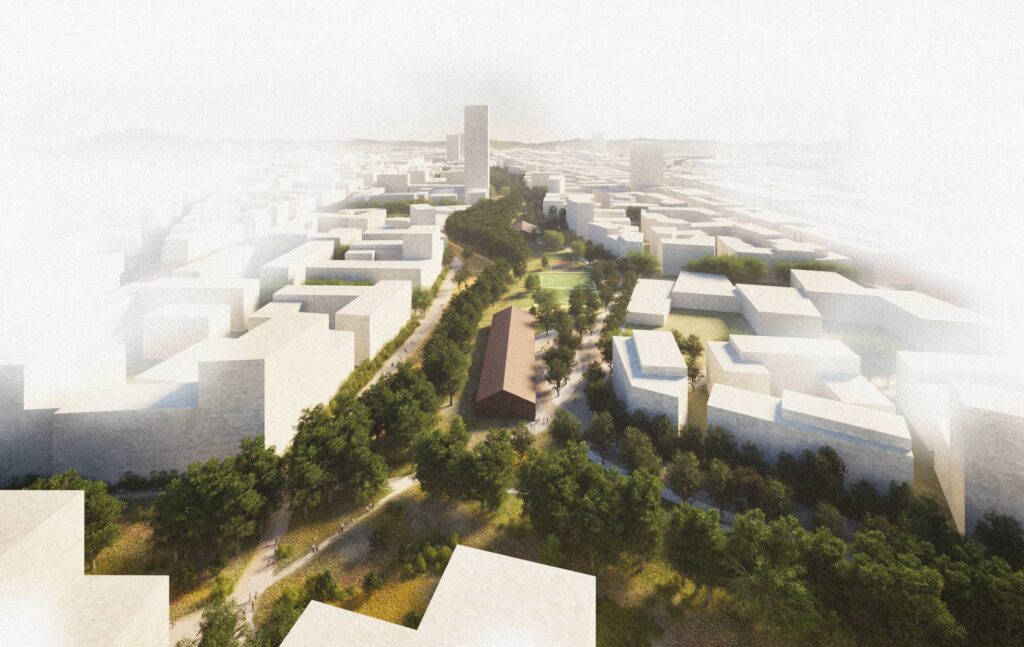
The intervention area of about 6.3 hectares is bordered to the south by the Tronto River and to the north by large residential complexes. It includes sports areas, children’s playgrounds, a dog area, derelict areas, a recreational club and a worship building. In terms of accessibility, the private car is the predominant means of transportation, while public transportation is limited, and a bicycle and pedestrian path is the only infrastructure to make use of the green areas.
The area has an anthropized vegetation component with the presence of urban rows of trees along the main roads, isolated trees, and a wide range of riparian vegetation along the river. Benches, picnic tables, and trash cans are present, but their distribution is uneven. Street lighting is present only along the bike path and the road system
The new public park is designed according to the “Parco della Salute” protocol, which envisions the creation of a large urban area for the entire population, including specific targets (the elderly, children, adults, sportsmen, etc.), as well as for domestic and wild animals, pleasant, inclusive and socializing, aimed at meeting and interaction, safe and ecosystemic, rich in biodiversity, also furnished according to the principles of Urban Health, properly maintained and supervised, designed to save natural resources, close by, intended to become a place that promotes health, contributing both to counter air pollution and to provide psycho-physical well-being to those who frequent it.
The project is articulated through the following main areas that affect the intervention area in general:
network of paths: the existing system of bicycle and pedestrian paths, basically represented by the bicycle and pedestrian path, will be integrated with the addition of new stabilized paths in order to allow access to areas that are currently unreachable and guarantee the better use in general of the existing and new green areas;
tree rows: rows of trees will be planted along the existing and project paths to provide shading for the paved surfaces and thus better thermal comfort;
hedges and shrub patches: the project involves the creation of linear plant formations with the dual function of separating areas with different functions and strengthening the ecological connections between existing and project vegetation groups;
street furniture: the project includes the installation of benches, picnic tables, drinking water fountains and waste containers along the new routes and to complement the existing furniture;
street lighting: the new paths and the play area will be provided with a lighting system on poles to complement the existing one that characterizes the bicycle and pedestrian path.